Rentals at Urby’s Jersey City skyscraper hit the market from $2,000/month

The 713-foot tower is one of New Jersey tallest and comes with 762 apartments

New Aerial Photos Showcase Almost-Finished 50 West Street in Financial District

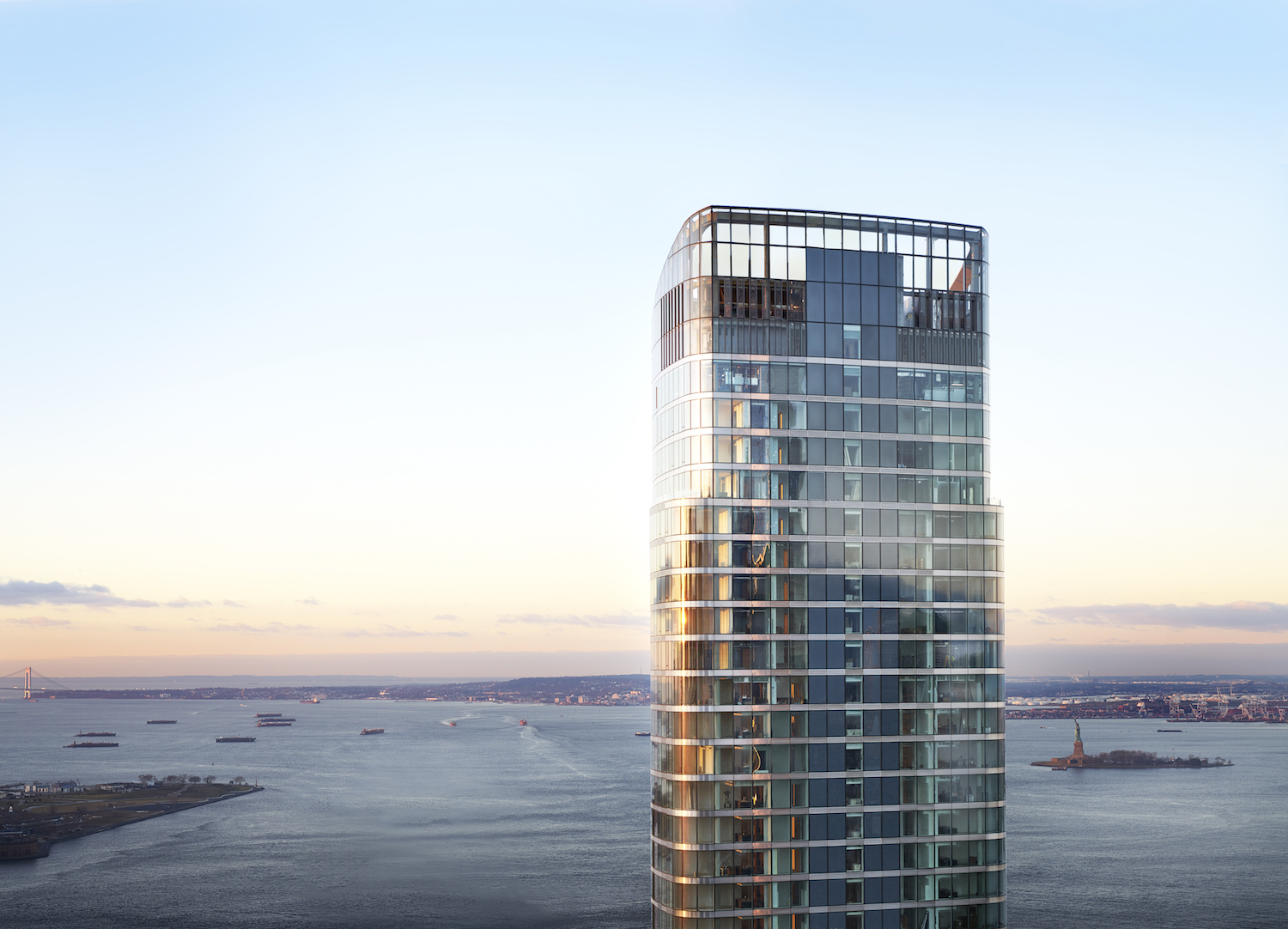
The crown of 50 West at sunset. photo by quallsbensonThe crown of 50 West at sunset. Photo by quallsbenson.

The Helmut Jahn-designed, 64-story skyscraper at 50 West Street is nearly complete and ready for residents, YIMBY has some stunning new photos, shot from a helicopter, of the 784-foot-tall tower in the Financial District.

Time Equities developed the luxury building, which features a curved facade and offers panoramic, floor-to-ceiling views of the World Trade Center, New York Harbor and the Hudson and East rivers.

A northeast facing view of 50 West Street, with the Woolworth Building and the Manhattan Bridge in the background. photo by <a href="http://www.quallsbenson.com/">quallsbenson</a>

A northeast facing view of 50 West Street, with 40 Wall Street and the Manhattan Bridge in the background. Photo by quallsbenson.

Buyers started closing on condominium purchases last month, and the developers just unveiled two new model units. Asking prices for the development’s 191 units start at $1.76 million, and two dozen units are still up for grabs on StreetEasy, including a three-bedroom, three-and-a-half-bath penthouse for $24.54 million. Sales have evidently been stop and go, because the first units in the building hit the market two and a half years ago. The tower has been in the works since 2007, but the recession derailed construction until 2013.

The building now has a temporary certificate of occupancy, and owners are expected to start moving in over the next few months. Construction is scheduled to finish this spring.

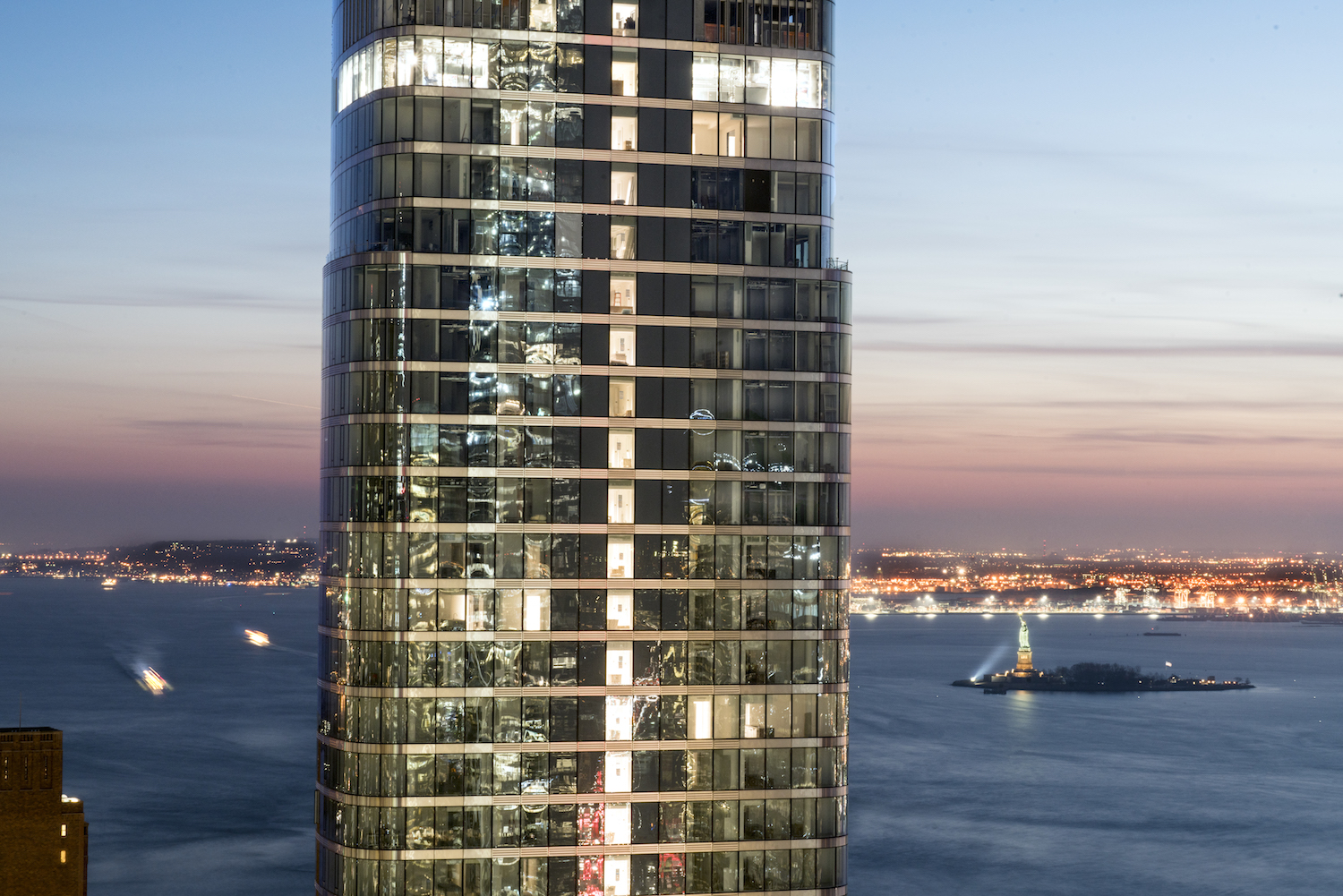
A nighttime view of 50 West. photo by <a href="http://www.quallsbenson.com/">quallsbenson</a>

A nighttime view of 50 West. Photo by quallsbenson.

Famed Danish designer Thomas Juul-Hansen handled the interiors, which are outfitted with marble vanities, marble floors and rain showers.

The development will also offer four floors of amenities, including a landscaped rooftop called The Observatory at 50 West, an entertainment floor with private dining room and terrace, a fitness center and The Water Club, which has a 60-foot-long pool, a Jacuzzi, steam room and sauna.

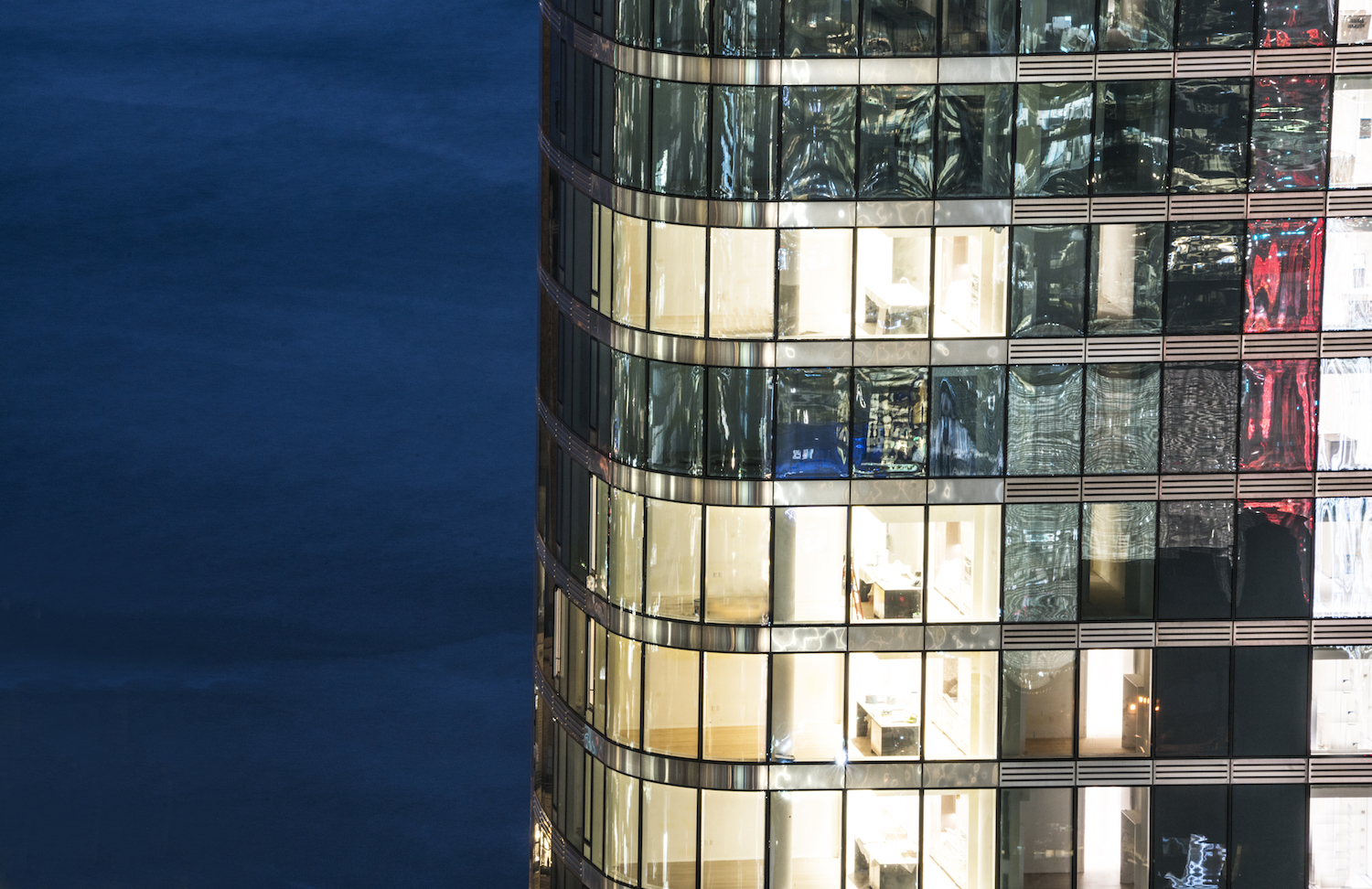
A night-time facade closeup. photo by <a href="http://www.quallsbenson.com/">quallsbenson</a>

A night-time facade closeup. Photo by quallsbenson.

There will also be a small commercial component to the project: the third floor will have 15 office condominiums and a conference room.

Like many of the city’s tallest towers, this one comes with some privately owned public space. Time Equities is creating a 6,800-square-foot public plaza with an art gallery, cafe, plantings, tables, and chairs. The plaza was originally supposed to generate a zoning bonus for 50 West. But after the financial crisis, the developers scaled down the size of the tower and chose not to use the bonus, the Wall Street Journal reported in July.

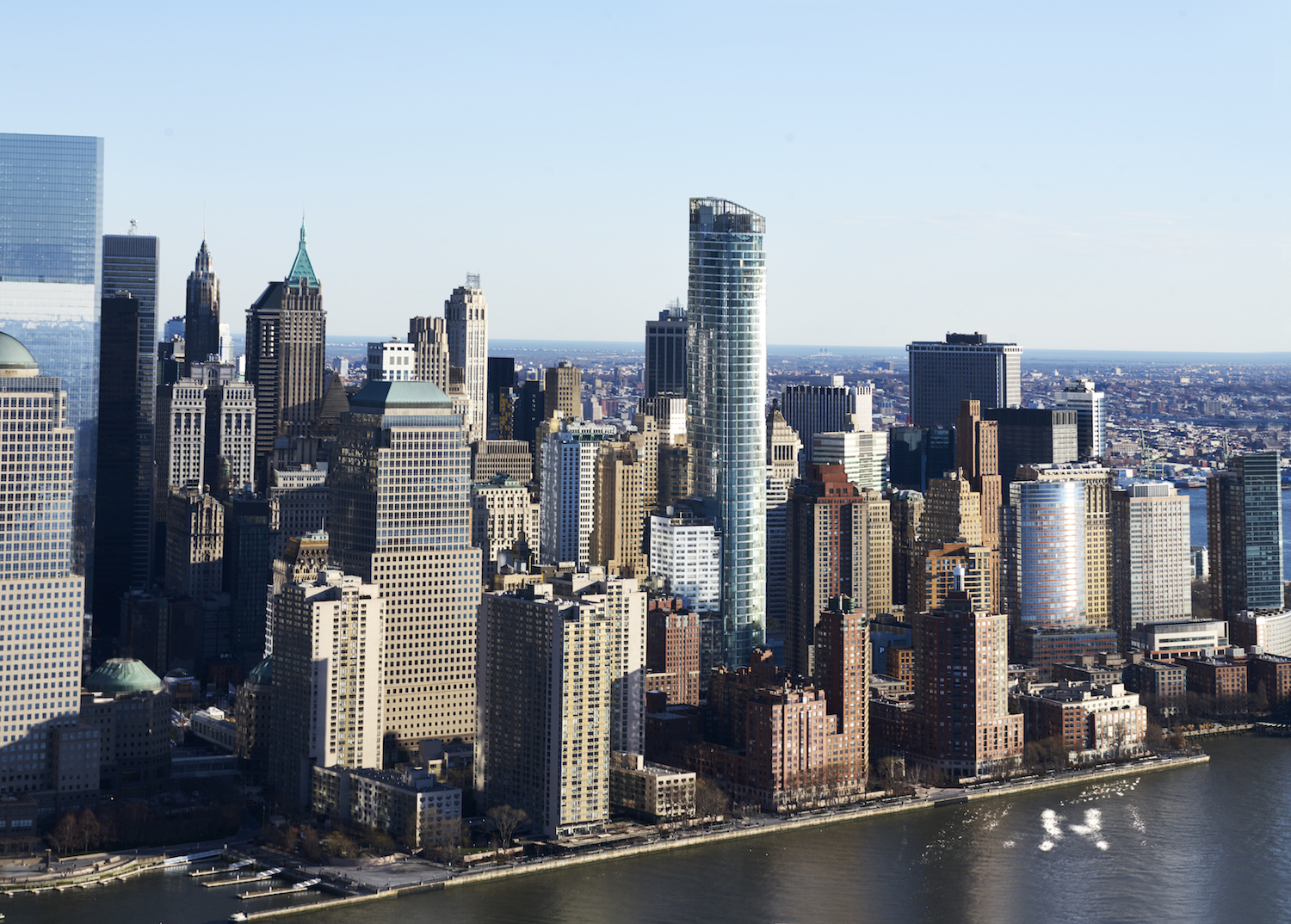
50 West makes its mark on the Lower Manhattan skyline. photo by <a href="http://www.quallsbenson.com/">quallsbenson</a>

50 West makes its mark on the Lower Manhattan skyline. Photo by quallsbenson.

The space will serve as a landing for the 230-foot-long West Thames Street Bridge, which will ferry thousands of commuters across six lanes of West Street every day. The bridge has been in the works for nearly a decade and will replace the Rector Street Bridge, a structure erected to temporarily replace a pedestrian bridge destroyed on September 11, 2001. The cost of the project has swelled from $20 million to $40.5 million over the years. $33 million will come from the Department of Housing and Urban Development, and Battery Park City Authority, which will be responsible for maintenance, is contributing $8.2 million. The city finally started work on the bridge in November.

50 West looks like it should dominate the skyline, but it doesn’t even crack the top ten tallest towers in the Financial District. It’s slightly shorter than the century-old Woolworth building, which reaches 792 feet above Broadway. The Robert A.M. Stern-designed Four Seasons condo-hotel at 30 Park Place was finished last year and stands 937 feet tall. Gehry’s wavy condo tower at 8 Spruce Street has a height of 870 feet, and the 71-story 40 Wall Street (pictured above), an office tower controlled by President Donald Trump, is 927 feet tall. One World Trade Center remains the loftiest in the neighborhood and the city, at 1,776 feet tall.

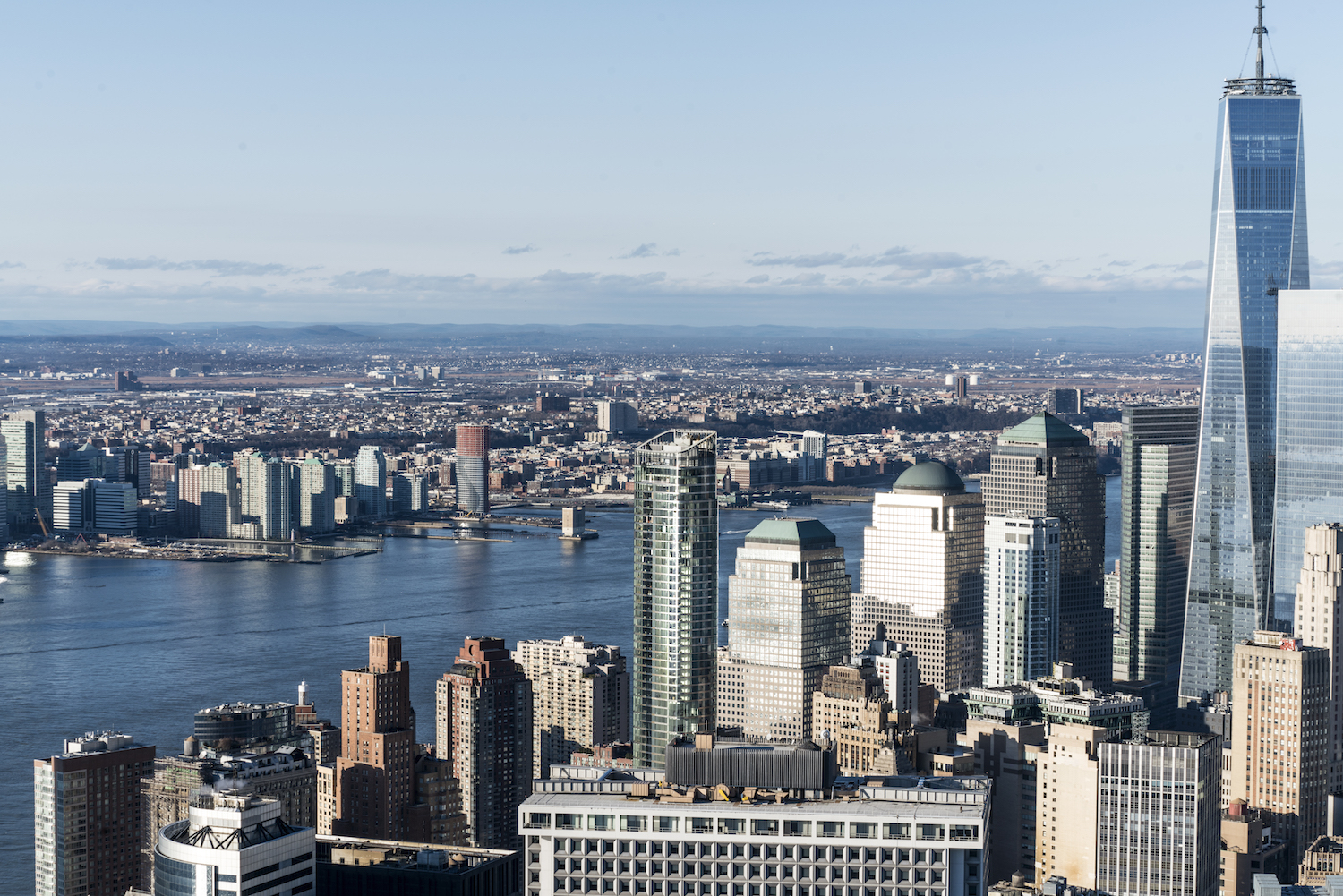
A northwest facing view of 50 West Street, with New Jersey in the background and One World Trade Center on the right. photo by <a href="http://www.quallsbenson.com/">quallsbenson</a>

A northwest facing view of 50 West Street, with New Jersey in the background and One World Trade Center on the right. Photo by quallsbenson.

CitizenM developing pre-fab hotel on the Bowery

300-room building arrived from Poland in 210 pieces

January 09, 2017 08:16AM

Construction at 185 Bowery and a rendering of citizenM’s hotel (credit: the Rinaldi Group)

Hotel developer and operator citizenM is planning the 20-story, 300-room project at 185 Bowery.  A Dutch company constructed the building in Poland and shipped it to New York in 210 pieces, the Wall Street Journal reported.

CitizenM, which has nine hotels operating and 14 in development, has used modular construction to build the majority of its properties in Europe, where the technique is widespread.

While the method isn’t always less expensive than traditional construction, it does allow for quicker assembly. CitizenM’s hotel, co-owned by Brack Capital Real Estate, is expected to take three to four months to finish, compared to six to nine months using traditional methods.


It will also cut down about 1,200 truck deliveries to the site.

“That is the beauty of modular construction,” said Anthony Rinaldi, of  construction manager the Rinaldi Group. “It really minimizes disruption to the neighborhood, to the community, to the traffic flow.”

New York’s fledgling modular industry is hoping the project will be a boon, illustrating the time-saving benefits.

“So much centers on how quickly you get the hotel full,” said Roger Krulak, chief executive of Brooklyn-based Full Stack Modular.

In October, Full Stack bought Forest City Ratner’s modular-building business, ending the developer’s brief and largely unsuccessful foray into the world or prefabricated construction. [WSJ] – Rich Bockmann

Why real estate should be wary of Trump’s tax plan

  • Fortis Editors Note: we publish the following article with guarded optimism for the success of the new administration. But more importantly, we hope that he succeeds in all burdens that weigh so heavily on the Presidency.  As a measure of reality soon encompasses and removes the campaign bluster, we sincerely hope that the President elect carefully chooses the correct path for our people. The Real Estate sector would certainly want to see prosperity and gains in our dealings, but not at the expense of  people and institution’s less fortunate or simply in the wrong place and time.   The shoes of the Presidency are quite a burden to fill, and we wish the soon to be new “President” Trump success and triumph, for our sake and the worlds. God Bless America and Happy New Year!   DJM, MD  Fortis Investment Group  
The president-elect’s proposals could lower home values and selling prices
December 01, 2016
By Kenneth R. Harney

trumpmortgage

Could the election of Donald Trump have unanticipated impacts on the federal tax code’s benefits, which favor  homeownership over renting?

To the extent that the House, Senate and White House soon will be under one party’s control, the answer may well be yes. Though housing issues got scant attention during the campaign, Trump’s tax reform plans, linked up with versions already proposed on Capitol Hill, could contain some jolts for many people.

Late in the campaign, Trump revised his earlier tax plans in ways that make it more compatible with House Republicans’ tax “blueprint” issued this past June. Trump would collapse the current seven tax brackets for individuals to just three: For married joint filers with incomes less than $75,000, the federal marginal tax rate would be 12 percent. For those with incomes of $75,000 but less than $225,000, the rate would be 25 percent. From $225,000 up, the rate for married joint filers would be 33 percent. Single-filer rates would have the same brackets but be based on incomes half the amounts for married joint filers. The capital gains rate would remain capped at 20 percent, and the controversial 3.8 percent “Obamacare” surtax on certain investment income would disappear.

Now it gets more intriguing: To simplify the tax system and wean more taxpayers from itemizing deductions on Schedule A of their returns, the Trump plan would boost the standard deduction for joint filers to $30,000 (up from the current $12,600) and raise it to $15,000 for single filers, instead of $6,300 at present. For very high income earners, there would be a limit on all itemized deductions of $200,000 for married joint filers and $100,000 for singles.

There’s no mention here of limits on mortgage interest deductions, so from strictly a homeowner or buyer perspective, nothing jumps out as objectionable. Simplicity is good. In fact, the original Trump tax plan exempted the mortgage interest and charitable deductions from the sorts of modest limitations contained in Hillary Clinton’s proposal.

But here’s a key question: With a substantially increased standard deduction of $15,000 to $30,000, how many homeowners will want to file for mortgage interest or property tax write-offs, as many do today. The chief economist of the National Association of Home Builders, Robert Dietz, estimated that the number of itemizers might drop from the current 25 percent of taxpayers to anywhere from just 5 percent to 10 percent.

Is that a problem? It depends on how one views the longtime tax code preferences for encouraging ownership of homes over renting. One analysis, provided by Evan M. Liddiard, senior federal tax policy representative for the National Association of Realtors, maintains that if the standard deduction is raised dramatically, “itemized deductions become less relevant,” and previously valuable and distinctive “tax incentives [for] homeownership evaporate even while taxes are not necessarily being reduced.” There’s less incentive to own rather than rent.

Dietz put it this way: When you decrease the attractiveness of a longtime subsidy devoted to encouraging purchases by lowering financing costs, “the economics would reduce the tax benefit for homeownership.” Such a change could “increase the after-tax cost of paying the mortgage,” he said.

Tax reformers see the issue starkly differently. Most comprehensive proposals that have been made in recent years, notably the landmark, bipartisan Simpson-Bowles National Commission on Fiscal Responsibility and Reform, call for wholesale elimination or sharp reductions of special interest carve-outs in the tax code.

But could limiting or ending homeownership tax preferences have the side effect of lowering home values and selling prices? Academic researchers suggest the answer is yes. A new paper from an economist at the Federal Reserve estimates that eliminating the mortgage interest deduction alone would cause the average household to lose
“10.9 percent of the value of the house, with homeowners losing 11.5 percent and homebuyers 8.5 percent.”

The Fed study did not address the type of tax plan contemplated by Trump or Capitol Hill reformers but appears to agree with the broad conclusion of earlier researchers: When you diminish the value of a subsidy benefit from a favored asset category, the value of that asset to potential buyers or owners is likely to drop.

None of this is happening yet. Months of committee hearings and debate — and lobbying — are guaranteed before any tax plan gets to the president’s desk. But it’s an indication of what’s on the line for real estate.

Kenneth R. Harney is a syndicated columnist.

10 New York Sites Get Landmark Status as Panel Clears Backlog

The Bergdorf Goodman department store had opposed designation as a New York City landmark since it was first proposed in 1970, but support from the community helped the building ultimately win protection. Credit Benjamin Norman for The New York Times

It has taken more than two years to resolve the bureaucratic quagmire of backlogged buildings at the New York City Landmarks Preservation Commission. Considering that some have been in limbo for four decades, it may have seemed like no time at all.

“This is really a mammoth undertaking,” Meenakshi Srinivasan, the chairwoman of the commission, said at a hearing on Tuesday at which the agency considered the fate of the final 13 of 95 properties on its backlog. “We can change the course of the commission’s practice to be better, more responsible, and timely. The process has been efficient, transparent and also incredibly rigorous, essentially starting from scratch and going back to all of these buildings.”

Ten buildings were designated as official landmarks on Tuesday, including the Bergdorf Goodman department store on Fifth Avenue. Of the remaining three, two did not win landmark protection, while a decision on the third was delayed. Preservationists said they wished more had been saved, but were grateful that in clearing its backlog the commission had granted landmark status to 27 properties over the past nine months, including the Pepsi-Cola sign on the Queens waterfront.

The commission’s votes Tuesday were a reminder of how the backlog grew and offered a window into the workings of the group as it grappled with the competing interests of property owners, preservationists, civic groups and politicians.

Photo

The Pepsi-Cola sign in Long Island City in Queens is among 27 properties to have become official New York City landmarks over the past nine months; the sign received the status in April. Credit Hiroko Masuike/The New York Times

“We’re pleased they’ve addressed the backlog; no one likes the backlog,” said Simeon Bankoff, executive director of the Historic Districts Council. “But there were a substantial number of significant buildings that were not protected, and not protected because of political calculations.”

The Bergdorf building, which was designed by Ely Jacques Kahn and completed in 1928, is an example of a property that had been caught in a tug of war. The store had opposed designation since it was first proposed in 1970, but support from the community, particularly Gale Brewer, the Manhattan borough president, helped the building ultimately win protection. The Immaculate Conception Church of the Blessed Mary, Convent, & Priests’ Residence in the Morrisania area of the Bronx was not designated, however, because of opposition from the parish and the local councilman. The council has the option to veto the commission’s decisions so the agency is reluctant to make decisions the council is likely to overturn.

One exception on Tuesday was the Loew’s 175th Street Theater. Councilman Ydanis Rodriguez and Representative Charles B. Rangel have supported the United Palace, a congregation and cultural center that now owns the theater and opposes designation. Nevertheless, the commission wanted to protect the property because the former movie palace is a rare example of the extravagant Indo-Persian architectural style.

Debates over the fates of buildings have intensified since Mayor Bill de Blasio took office two years ago and focused on the development or preservation of 200,000 units of affordable housing.

Photo

The United Palace, a congregation and cultural center, now owns the Loew’s 175th Street Theater. The commission wanted to protect the property because it is a rare example of the extravagant Indo-Persian architectural style. Credit Fred R. Conrad for The New York Times

The real estate industry and critics of preservation have seized on the chance to seek changes, including clearing the backlog of cases before the commission. Initially, the commission was going to clear the backlog in late 2014 without considering any of the properties, a move that drew an outcry and was quickly reversed.

Many owners oppose landmark status because of the burden of receiving approvals for renovations, and fears that changes could be rejected outright.

Among the structures that were designated landmarks on Tuesday were a YMCA building in Harlem where the writers Langston Hughes and Richard Wright once lived and Paul Robeson sang; the Excelsior Power Company building on Gold Street in the Financial District; churches in Flushing, Queens, and Bushwick, Brooklyn; one of the last wood-framed houses on the Upper East Side; and two Colonial-era houses on Staten Island.

The Edgar J. Kaufmann rooms, designed by Alvar Aalto, did not win protection in part because they are in a building at the United Nations with high security and limited public access. The panel continues to work with Consolidated Edison to preserve the IRT Powerhouse on 12th Avenue while allowing it to operate as a steam plant.

The commission has held two other hearings on backlogged properties since spring, at which such recognizable sites as the Vanderbilt Mausoleum on Staten Island gained protection.

A year of change in store for NYC businesses

Donald Trump and the other forces poised to shape the city’s economy in 2017. Some industries will fare better than others

The EB-5 debate in full effect

Corporate welfare, legitimate financing or the corruption of American ideals? What opponents and stakeholders have said over the years

November 01, 2016
By Marynia Kruk


The EB-5 visa program, which grants foreigners a provisional right to live, work and study in America in exchange for investing at least $500,000 in job-creating business ventures, was extended once again in late September. But, in this case, only until Dec. 9, at which point the program will likely face significant changes if it doesn’t expire or get another short-term extension. And a major beneficiary of the policy — the New York City real estate industry — is closely watching the various proposed overhauls. Major developers including Forest City Ratner Companies, the Durst Organization, Silverstein Properties and Related Companies have taken low-cost loans from the program’s aspiring immigrants and used them to plug financing gaps on projects throughout the city.

Enthusiasm for such an arrangement isn’t surprising if one looks at the math. Foreigners agree to a below-market return on their investment (reportedly 1 percent in some cases) because they get something else out of it: a United States green card. Meanwhile, developers are able to reap the benefits of cheap financing by acting as middlemen for something that costs them nothing, another individual’s path to citizenship.

What is surprising is how long it took for EB-5 to gain traction. While Congress created the program in 1990 to help stimulate the U.S. economy, applications didn’t begin flooding in until after the 2008 financial crisis. That’s when developers’ and other entrepreneurs’ need for financing dovetailed with the desire of foreigners — overwhelmingly mainland Chinese citizens — to gain entry to the States. Most recently, EB-5 has become a victim of its own success.

A waiting list has made it less appealing for those who initially found the program’s quick turnaround enticing. In the first half of 2016, applications plunged 51 percent from a year earlier, according to the U.S. Citizenship and Immigration Services agency. And as major reform proposals get floated, including a potential increased price of entry, the possibility remains that all the scrutiny could doom the program in the long run. As the debate rumbles on, TRD takes a look at what stakeholders and opponents have said in recent months and throughout the years.

(Click to enlarge)

(Click to enlarge)

Breaking down Jared Kushner’s Chris Christie vendetta

Kushner Companies chief’s history with NJ politico goes back a decade

November 15, 2016 04:43PM
By Katherine Clarke and Grabrielle Paluch

Jared Kushner and Chris Christie

Jared Kushner and Chris Christie

New Jersey Gov. Chris Christie has had quite the week. First he was removed as the head of President-elect Donald Trump’s White House transition team. Now, his allies are being booted too. At the helm of that effort? None other than real estate developer Jared Kushner, Trump’s son-in-law and close consigliere.

Kushner is reportedly throwing Trump’s transition efforts into disarray by pushing out personnel who were tapped by Christie, Bloomberg reported. Former House Intelligence Committee Chairman Mike Rogers, who was tapped by Christie to lead national security planning, was among those ousted in recent days. The Kushner Companies CEO reportedly fought against having Christie on Trump’s election ticket, ruining his chances of becoming the country’s VP. It reads like a modern twist on “The Count of Monte Cristo.”

So what exactly is Kushner’s disdain for Christie? His distaste for the politician has been widely documented and linked to Christie’s involvement in the prosecution of Kushner’s father Charles Kushner, who was sentenced to prison in 2005 on 18 counts of tax evasion, witness tampering and making illegal campaign donations.

But to fully understand the genesis of the bad blood, you must look back to 2005, when Christie, then U.S. Attorney, pounded his chest over his success in getting a guilty verdict in the Kushner case. He’d pushed for Kushner to be sentenced to three years for his crimes, which included hiring a prostitute to seduce his brother-in-law and capture it on videotape in an act of retaliation against his sister, a witness for the prosecution. He told the New York Times that Kushner had failed to show an “acceptance of responsibility” in the case.

Kushner was ultimately sentenced to two years and served one. It sank his career and his chances of becoming the Chairman of the Port Authority of New York and New Jersey.

“It shows that no matter how rich and powerful you are in this state you will be prosecuted and punished for crimes you commit,” Christie said in a statement at the time. “This sends a strong message that when you commit the vile and heinous acts that he has committed you will be caught and punished.”

The win was said to have helped the sharp-tongued Christie brand himself as a tough-on-corruption candidate in preparation for his run for governor in 2009.

A young Jared Kushner, who’d learned of his father’s arrest while interning at then-Manhattan District Attorney Robert Morgenthau’s office, took the news particularly hard. In 2013, he told The Real Deal that he’d even changed his career course because of the handling of his father’s case.

My dad’s arrest made me realize I didn’t want to be a prosecutor anymore,” he said. “The law is so nuanced. If you’re convicting murderers, it’s one thing. It’s often fairly clear. When you get into things like white-collar crime, there are often a lot of nuances. Seeing my father’s situation, I felt what happened was obviously unjust in terms of the way they pursued him. I just never wanted to be on the other side of that and cause pain to the families I was doing that to, whether right or wrong. The moral weight of that was probably a bit more than I could carry.”

But Kushner and his father’s beef with Christie goes even deeper than his father’s prison time. They have also taken issue with the politician’s close relationship with Charles’ brother, Murray Kushner. The criminal proceedings against Charles reportedly stemmed from complaints made to federal election regulators by Murray. Beyond that, Murray continued to donate to the New Jersey Republican Party even after his brother was incarcerated.

There were allegations of impropriety, with the Kushners intimating that Murray had not come under the same legal scrutiny as his brother, the Newark Star-Ledger reported.

Charles and Murray had an acrimonious relationship from childhood. In 1999, it was Murray who scuppered a bid by Kushner Companies to acquire Berkshire Realty. The deal would have catapulted the Kushners into the top ranks of private real estate firms in America. The Blackstone Group ultimately won control of the real estate investment trust and its nearly 25,000 units with a $1.3 billion bid.

Charles also questioned Murray’s family life, primarily because he had married a shiksa (a gentile) named Lee. During Passover in 2000, an argument boiled over, leading Murray to tell Charles that if they were incapable of being partners, then they “can’t be brothers.” Shortly after that, Murray sued Charles over money he was allegedly owed from real estate partnerships, but the case was settled in arbitration and remains sealed.

Kushner put his father’s missteps behind him.

“My father made a mistake and he paid a big price for it, but he’s my father,” he previously told TRD. “He’s given me everything I have in terms of the skills and the training and taught me about being a man. I feel extremely lucky to have him in my life.”

But, in the case of Chris Christie, forgiveness may not come as easily.

Trump Tower residents mull selling amid protests: report

They’re having a difficult time getting in and out of the building

November 11, 2016 10:50AM

Trump Tower and Donald Trump

Trump Tower at 725 Fifth Avenue and Donald Trump

It’s a hard-knock life for the residents of Trump Tower right now, and some are considering jumping ship.

Protesters are making it difficult for residents to get in and out of the building, where the president-elect lives in a triplex penthouse, the New York Post reported. Security at the Fifth Avenue tower is ramped up. So, according to the Post, some residents are mulling selling their units.

“They can’t get into their own homes without being stopped and frisked and having to show ID,” one broker told the Post. “These are wealthy people. They don’t need this, and they can’t take it any longer. They no longer want to stay there. Some of them are already planning on moving out, and they’ll decide later whether or not they want to sell.”

Before Tuesday’s election, the Secret Service warned that if Trump TRData LogoTINY won the election, he shouldn’t stay at his penthouse at Trump Tower when he visits New York. At the time, officials told the Post that the building’s security measures weren’t president-ready. [NYP]Kathryn Brenzel